Sunday, October 31, 2010

Plot Arc: How You Can Badly Screw One Up

It's simple to follow a 3-act or 5-act structure in modern Hollywood films. It's also very simple to somehow screw this up. In Star Wars Episode III: Revenge of the Sith, George Lucas follows the 5 act structure almost perfectly, and yet his film still does not come across as very effective? Well, why is this? You're about to find out.

First, let's analyze what George Lucas does right with Episode III. First of all, we know that this one is solely about Anakin turning into Darth Vader. Why he decided to throw the *expletive* first two films at us before this is beyond me (it's green and rhymes with "honey"), but here we are, finally to the turn of Anakin from good to bad. This seems almost perfect for a 5-Act structure. It deals with the moral dilemma of Anakin Skywalker, and the climax is when he goes from good to bad. He got the right plot triangle.

So how does this plot shake out? Well, first, we start with this:
The beginning space battle not only gives Lucas his chance at throwing as much CGI as possible on the screen, but it gives him a chance of showing the good relationship between Anakin and Obi-Wan. Anakin is clearly good in this part of the film. We are shown that he is a hero, and despite doing a very un-heroic thing
like killing Count Dooku for instance, he is mostly regarded as a good guy, joking and laughing with Obi-Wan on their mission. The rescue of Chancellor Palpatine is the rising action, and Act I of the film. 

Act I lasts for about the first 30 minutes of the film, which is almost perfect for a 140 minute film (almost 1/5 of the movie). It lasts up until the first plot point, which is:
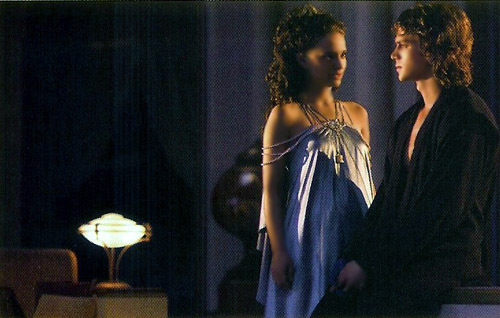
When Anakin has the dream of Padme dying and decides to stop it from happening, it is the first mini-climax, and the first plot point. The tension of Anakin is beginning as he does not know what to do about his prediction that his wife will die. This brings us to Act II, which follows Anakin trying to learn the powers he needs in order to save his wife, and befriending the evil Chancellor Palpatine to do so. This continues the rising action, and Anakin's tension continues to build as he is further frustrated by the Jedi Order. So far, Lucas is pulling this plot triangle off in near perfect form! All he has to do is continue this and he's got a great -- not so fast! We're only in Act II. Act III is the most difficult part, and it is where Lucas fails. Our next plot point comes about 35 minutes later, at the 64 minute mark: Anakin, after hearing that Chancellor Palpatine is evil (what a shocking surprise!), decides he's going to turn him in to the Jedi Council.
Hooray, Anakin is a good guy again! He isn't going to turn on the Jedi, so all is well!
So then 10 minutes later he kills the guy that he just decided to turn Palpatine in to, immediately regrets his decision, and then a minute after that kneels and becomes Darth Vader in quite possibly one of the sloppiest climaxes (no, that's NOT what she said) in cinematic history. The problem is, Anakin goes from good in the last plot point, then to bad 10 minutes later, then to good again when he regrets his decision, and then says "Oh well, I'll just become Darth Vader anyways" and murders children. As Professor Berg said, The middle part of the story is the hardest, and this is where Revenge of the Sith fails. Before this point, and after this point, there is a pretty good story (for Lucas's standards), but the climax is where the film fails. 

So let's wrap this thing up and call it a day. Act 4 begins after this climax, where everybody dies. Anakin kills the children (but there's still good left in him!), the stormtroopers kill the Jedi, Obi-Wan goes to kill Anakin, something with Yoda being called a "little green friend" (who wrote this garbage dialogue?), and then we get one of the worst acting performances put on screen.
I mean, seriously, Natalie Portman, you've been nominated for an Oscar. So have you, Ewan McGreggor (well, a Golden Globe, the point remains). This scene is not only a huge waste of acting talent, but it just downright sucks, and it is plot point 4. Anakin Force chokes Padme because he finds her lack of faith disturbing, so now he's completely turned on his life and the tension begins to fall. Sure, the action picks up (20 minute long lightsaber battle), but the tension is gone. Anakin is Darth Vader, now let's light him on fire and get this nonsense over with.
Ta da! This film should be lit on fire.

Sunday, October 24, 2010

Not that there's anything wrong with that: The Art of the Sitcom

Sitcoms: the bottom of the barrel in creativity according to many critics. The shows that pollute TBS and Nick at Night. The only thing to watch at 1 in the morning on cable television. Yet, sitcoms are almost always some of the most popular shows on television. From Seinfeld, to Friends, to Everybody Loves Raymond, to recents such as Modern Family or The Office, sitcoms continue to be a very prevalent and popular part of television programming. So why are these referred to as "not very creative" by some critics? Well the answer is that they follow the same basic structural patterns. Most sitcoms run about 22-24 minutes an episode, and fit into a half-hour time block, aside from some season finales or premieres. They also feature an episodic structure, where you don't need to see previous episodes to understand what's going on. Some shows, such as Friends or The Office, feature episodic content but also have some overarching storylines (such as the Ross/Rachel and Jim/Pam romances). Sitcoms also usually follow a basic, 3 act structure and very little character development, which makes the characters very flat, another criticism.

Recent shows have attempted to keep this same structure and make the show feel like a sitcom, but they change up some of the basic character stereotypes. A great example of this would be the Emmy-award winning sitcom: Modern Family. Modern Family follows 3 different families, the "normal" family with a mom, dad, and 3 children, a gay couple with their adopted Asian baby, and an old man and a young Latino woman who have recently married. Modern Family takes the classic TV family stereotypes and turns them upside down. The structure is fairly episodic, aside from one or two references to other episodes, and follows the basic 3-act structure and 30 minute time block that most other sitcoms use.
The key difference for Modern Family, is that rather than focusing on 2 or 3 main characters, and adding in a bunch of less important characters (The Office, Friends, and Seinfeld are all culprits of this), or just focusing on one family (Everybody Loves Raymond), Modern Family can focus on 3 different families, and focus on a different main character every week. This offers a refreshing take on the sitcom genre, and it is probably why it dominated the Emmys this year.

Sunday, October 17, 2010

Killing Nazis and Sarah Connor: Examples of angle use in modern films

As the old cliche goes: it's the little things that matter. In film, this is no exception. Sure, audiences may not be praising filmmakers for their impeccable use of angles or camera movements, but such things are very important to the overall effect of a film. When watching a film, you may not even notice how these things are used, but your brain does. The way filmmakers use angles is very important to how people feel about the film. They help set moods, and help establish characters.

One example is a stand out scene from the 2009 film "Inglourious Basterds" (Directed by Quentin Tarantino):
When the "Bear Jew" enters the scene after a dramatically long sequence in which he taps his bat against the wall, the scene is shot from a low angle to show the dominance that he has over the Nazi soldier. This low angle gives the "Bear Jew" a lot of power, and shows that he is a very daunting figure. The shot also follows the basic shot progression by starting with a longer shot.
The scene continues to shoot him at a low angle, but switches to a medium shot.
Meanwhile, the Nazi soldier is shot at a high angle, removing power from him. The soldier is essentially helpless, and the angle portrays that. The medium shot is used here as well.
Now, the shot is a close up to show the emotion of the scene. The "Bear Jew" hates Nazis, and he is very angry. The shot is also tilted to make the shot more interesting. The low angle is consistent.
This shot is almost the same as the last one by being tilted and a close up, but the Nazi is shown from the high angle. This again removes his power. He is, to be blunt, about to get his head bashed in by a baseball bat. He is staring at his death.

The use of angles in this scene tells pretty much everything about the characters without really having to use any other means.

Another example is from the 1984 film "The Terminator" (Directed by James Cameron):
As the Terminator approaches Sarah Connor in the bar, he is shot in a low angle. Not only does this give him an incredible amount of power (he is shot in low angle for nearly the entire film), but it gives him the  appearance of being incredibly tall.
Meanwhile, Sarah Connor is shot from high angle, to give her the helpless attribute.
As the Terminator pulls the gun out, the low angle is used again.
The low angle is used again for Sarah, but now it is a close up shot of her face. This, just like the scene from "Inglourious Basterds" is used to show the emotion of being near death. Sarah believes that she is about to be killed at that moment, and this close up shows her emotions, while the high angle shows that she can do nothing about it.

Both of the aforementioned scenes are nearly exactly the same. Both show a daunting figure about to kill a helpless victim, and are shot in nearly the same way. They both follow the basic shot sequence of starting with long shots and getting closer as the scene continues, and both use the low and high angle shots effectively.

Sunday, October 10, 2010

Film Spam: How movie studios dominated the industry

Classical Hollywood is often referred to as the Golden Age of Cinema. A number of classic films that are still highly regarded today were produced during that time period. The problem with this "Golden Age" was that for every one great film produced, there were dozens and dozens of terrible ones. The reasoning behind this was simple: in order to eliminate competition, they had to produce as many films as possible to fill up the theaters. This "block-booking" was the reason that the Big Five dominated the film industry at this time. The theaters would simply have no more room to play other films from independent filmmakers as an example.

Overall, this spam had a negative effect at the time on the cumulative quality of films, because the vast majority of movies were not carefully planned out and executed. You would have one or two great films a year, and then a slew of downright awful movies. At the time, this probably weakened the overall effectiveness of films. In recent years, however; we look back and see only the great ones, but nobody ever hears about the bad ones, which means that in the long run, this didn't actually hurt the studios that much.

But, alas, in 1948, the Supreme Court ruled that this practice of "block-booking" was anti-competitive, and placed restrictions on the studios. This didn't completely eliminate the practice, but it did stop the overwhelming spam that the studios kept creating, and led to the weakening of the studio system. An example of "block-booking", in 1977(not in the classic studio era, but the concept remains the same), there was this little film that was coming out, you may have heard of it:
Unfortunately, nobody wanted to show this film at their cinema. Luckily, thanks to this "huge blockbuster" called "The Other Side of Midnight" (which quite ironically was nowhere even close to Star Wars in box office totals), also made by 20th Century Fox, "Star Wars" actually got put into theaters. Fox told theaters that if they wanted to show "The Other Side of Midnight", they had to show "Star Wars". This is a great example of how block-booking, when not overdone, can be a good thing. The problem was, in classical Hollywood, they well for the overkill effect.

Sunday, October 3, 2010

Lucky there's a Family Guy...

When "All in the Family" was released, it was one of the most controversial shows on television. The creator, Norman Lear, thought that Archie would be a great social critique on many Americans' attitudes, however; many people thought he went way too overboard.

So, today, what's the most controversial show on television? What's the show that the FCC is constantly having to look out for? Well, I'll offer a visual comparison of the opening to "All in the Family" with the intro of that show:
It's obvious in both the similar intros and the show's title that "Family Guy" was heavily influenced by "All in the Family" and is striving to be the same type of show. Both shows are heavily controversial, covering topics such as politics, sexual orientation, racism, and others. Both shows also used a fair amount of language. "All in the Family" was among the first to use "God damn it" on TV, and "Family Guy" drops numerous swear words, including F-bombs on the unedited DVD releases. 

No matter how similar these shows are, though, there are still various differences between the two. For example, "Family Guy" is animated (thank you Captain Obvious!), and features a much different narrative structure (various cutaway scenes and anecdotes). Really, "Family Guy" seems more based on "The Simpsons" than "All in the Family", but it is still the best modern comparison to it. "All in the Family" also uses much more racial slurs, whereas "Family Guy" uses stereotypes but not very many slurs. 

Content-wise, both shows don't really fail to address topics that the other does address, other than "Family Guy" addressing a few modern issues such as abortion or gun rights that weren't as prevalent during the times of "All in the Family". But really, neither show holds back that much. They both go boldly where no show has gone before, and address things that other shows would fear to delve into. 

Sunday, September 26, 2010

Video killed the Radio Star...but so did piracy...and the iPod: Technological Change in the Radio Industry


In 2001, Steve Jobs unleashed what has been quite possibly the biggest change in the music industry ever: the Apple iPod. The iPod, introduced in 2001, held 1000 (highly compressed) songs in your pocket that you could take anywhere. This product completely revolutionized the music industry by eliminating the hassle of carrying CDs around and having to change CDs whenever you wanted to play a different artist. Today, that technological change, combined with Apple's software iTunes has severely hurt the radio industry, and caused some radical changes in the music industry altogether, by creating a music and radio industry that is based on digital downloads and sales.

"But that's not the radio industry in the 1920's; tangents are fun, but that paragraph is completely off topic!" It is, but let's be honest here, you weren't around in the 1920's, and neither was I. However, the above example from today can easily be compared to the technological change in the 1920's, which created the commercial radio industry.

Technological change is one of the most driving forces in the world. From the printing press, to radio, to television, and most recently the internet, technological change does not only change the industries around the world, but it changes people around the world. It changes how people communicate and how people give and receive information. The change that will be discussed here is the invention of the radio.

In Greek mythology, the Phoenix is a bird that rises from the ashes. Of course, this analogy is referring to the birth of the radio from the "ashes" of the Titanic. The Titanic disaster not only used radio to send for help,
                                                   (and made James Cameron a billionaire)

but the news of the disaster was broadcast over the radio and thus, the radio industry was created. People, companies, and even the government now knew how powerful of a technology they had on their hands. Sure, the radio was invented before this moment, but it was after the Titanic disaster that everybody realized that it was a viable technology. People flocked to the airwaves, and in the span of about 10 years, hundreds of radio stations had been established. Now, news, music, and various other shows were being broadcast to thousands of people, and the media spread much more quickly.

So there are the 1920s! But how has radio held up today? With the inventions of television, computers, and the internet, the radio is becoming much less of a factor, however; the industry is now in a state of conversion. Many radio stations are still around, but a majority of them have set up online streams that one can access from their mobile devices or their computers. Other, new types of radio stations such as Pandora (my personal favorite) seek to broadcast music, but personalize it to each user's taste by providing them with songs that are similar using "29 proven dimensions of compatibility". Wait, that's E-harmony's slogan. Well, it's still the same basic concept. Songs that have similar things get played. I predict that the actual radio waves will soon be coming to an end, and cars will eventually get nationwide internet connectivity. The movement to the internet would eliminate the need for a bunch of radio towers, and would probably use the 3G (or whatever-G in that time) towers which have already been built. It's a convergence, and probably the future. As you can see, radio continues to be shaped by new technology, even today.

Sunday, September 19, 2010

"Social" Networking is the ultimate irony (or, "Internet addiction and you!"; whichever title you prefer)

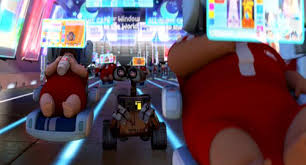
In 2008, the Pixar animated film "Wall-E" debuted in theaters. The story of a human race who had become so dependent on products and technology that they had completely destroyed not only Earth, but human life as a whole. No, it's not just the story about some "kiddie robot". Anyways, "Wall-E" envisioned the great improvements to human life in the upcoming years, as seen by this still frame:


As you can see, our society has succeeded in becoming absolutely useless. But this is just an exaggeration. There's no real danger of our human race becoming this way. See:


Wait, that's not right. Here:


Our human race is already beginning to exist this way, due to addiction to media. Media addiction is another negative effect of the media, on par with the cultivation theory, stereotypes, etc. It essentially is the inability of a person to stop using a certain form of media. The example from "Wall-E" is just an exaggeration, sure, but the number of people who are becoming exactly like that is increasing exponentially. According to Facebook, the average user spends 7 hours a month online, and even more if you have Facebook on your mobile device. As Betty White said on Saturday Night Live, "Sounds like an awful waste of time". Betty, you couldn't be more right. 


The basic premise behind Social Networking is simple: make it easier for friends to connect to each other, and allow people to meet new friends. Social Networking, by design, is meant to be a "side item" (if you will) to the "entree" that is a person's social life. The problem that has arisen, and continues to rise, is the fact that people have swapped their hamburgers and french fries. A great number of people have begun to use social networks as their main social life, and allowed their real-life social life to fall by the wayside. People aren't using Facebook, Twitter, or MySpace as a compliment to their social life, they are using it as a substitute. 


In trying to become more friendly with people, they become more isolated. This anti-social behavior, or, behavior that society does not value, is leading to more shallow interaction between people in the world. While violence and sexual activity are seen as anti-social behaviors, I would argue that isolation is bigger than all of these. But what causes this isolation? Do people like their friends so much (no pun intended, you habitual facebookers) that they have to stay connected with them at all times, or is it something else? The problem that is going on isn't the hunger for a social life, it's the addiction to the media that is the internet. It's a very basic version of Second Life, or even World of Warcraft and we have seen how addicting those can get. People like placing themselves in a controlled environment, which is a majority of social media sites. They can pick and choose which parts of their personality and image to portray online, which fragments a big part of basic human interaction. The scary part about Facebook is the addition of applications. Various games and apps keep people coming back, and actually endanger people's private information by allowing access to pretty much everything.


So will the future end up like "Wall-E"? While it shouldn't ever get this extreme due to the *ahem* certain drives of people that I won't go into in this blog, I think it will approach this to a point. People will become so reliant on media to interact with each other, that a majority of people will have trouble interacting with others in real life. It's already happening to thousands, if not millions of people. And while you were reading this blog, how many times have you checked your Facebook/Twitter/MySpace?